
Strategic Sales Leadership
- Driving revenue growth through strategic planning and execution for large-scale enterprise accounts.
- Building and leading high-performing sales teams aligned with organizational goals.

Client Relationship & Business Development
- Establishing and nurturing long-term partnerships with key clients across industries.
- Leading complex negotiations and securing multi-million-dollar deals.


Market Expansion & Growth Initiatives

Thought Leadership & Team Development
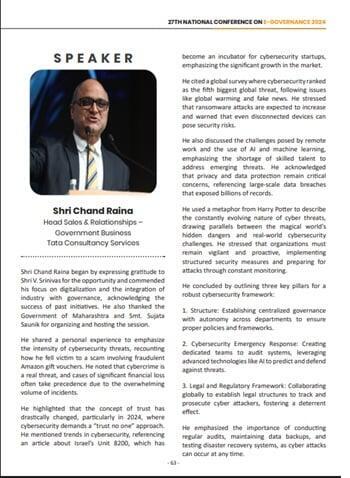
Cybersecurity - Harry Potter Analogy
Shri Chand Raina began by expressing gratitude to Shri V. Srinivas for the opportunity and commended his focus on digitalization and the integration of industry with governance, acknowledging the success of past initiatives. He also thanked the Government of Maharashtra and Smt. Sujata Saunik for organizing and hosting the session. He shared a personal experience to emphasize the intensity of cybersecurity threats, recounting how he fell victim to a scam involving fraudulent Amazon gift vouchers. He noted that cybercrime is a real threat, and cases of significant financial loss often take precedence due to the overwhelming volume of incidents. He highlighted that the concept of trust has drastically changed, particularly in 2024, where cybersecurity demands a “trust no one” approach. He mentioned trends in cybersecurity, referencing an article about Israel’s Unit 8200, which has
become an incubator for cybersecurity startups, emphasizing the significant growth in the market. He cited a global survey where cybersecurity ranked as the fifth biggest global threat, following issues like global warming and fake news. He stressed that ransomware attacks are expected to increase and warned that even disconnected devices can pose security risks. He also discussed the challenges posed by remote work and the use of AI and machine learning, emphasizing the shortage of skilled talent to address emerging threats. He acknowledged that privacy and data protection remain critical concerns, referencing large-scale data breaches that exposed billions of records. He used a metaphor from Harry Potter to describe the constantly evolving nature of cyber threats, drawing parallels between the magical world’s hidden dangers and real-world cybersecurity challenges. He stressed that organizations must remain vigilant and proactive, implementing structured security measures and preparing for attacks through constant monitoring. He concluded by outlining three key pillars for a robust cybersecurity framework: 1. Structure: Establishing centralized governance with autonomy across departments to ensure proper policies and frameworks. 2. Cybersecurity Emergency Response: Creating dedicated teams to audit systems, leveraging advanced technologies like AI to predict and defend against threats. 3. Legal and Regulatory Framework: Collaborating globally to establish legal structures to track and prosecute cyber attackers, fostering a deterrent effect. He emphasized the importance of conducting regular audits, maintaining data backups, and testing disaster recovery systems, as cyber attacks can occur at any time.
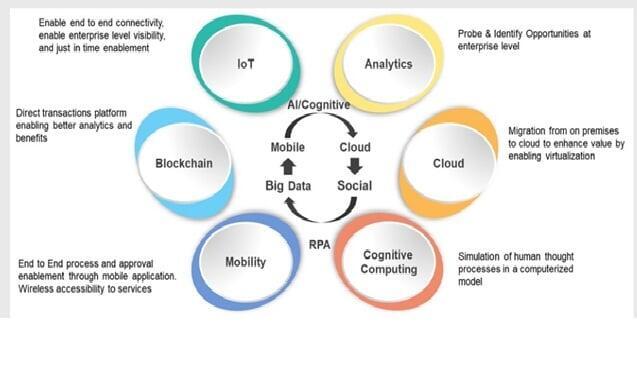
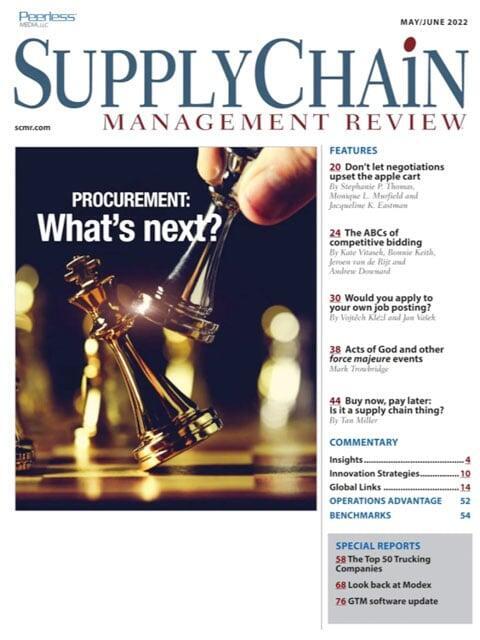
Reimagining the procurement operating model for tomorrow
All organizations, irrespective of the nature of their business, are dependent on external
vendors for most of the materials and components comprising their products and services.
External vendors play so much a part of the current operating model that organizations
cannot be sustained without their support. We are emerging from the unprecedented challenges
thrown at us by the COVID-19 pandemic. It has significantly changed the basic ways
in which operations are planned and executed, necessitating procurement leaders to transform
their operating model to align with a revised organizational business operating model
Reimagining the procurement operating model for tomorrow - Supply Chain Management Review

Sovereign and secure – the key tenets of governance today
Not much has changed except the volume, velocity and strategies that have been consistently transforming the world.
Over 5,000 years ago, ancient Sumerians recorded harvest yields and tax ledgers on clay tablets. The Egyptians curated vast libraries of religious texts and historical accounts, while Indian temples preserved the rituals and religious information and were entrusted with astrological records, agricultural information, and taxation details. We are aware about how war strategies were formulated secretly and executed with precision; any leakage of even a small bit of information would be disastrous. Therefore, each set of information was so sacrosanct that only strong, loyal, and wise were entrusted to serve as secret keepers. This was to ensure the security, integrity and governance of the information.
https://www.tcs.com/insights/blogs/sovereign-cloud-innovation-national-security
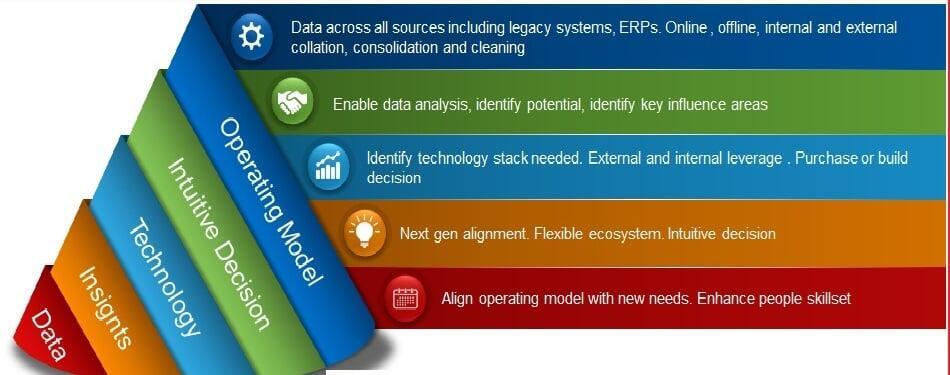
Digital Shared Services - Looking Beyond Conventional Model
The white paper deals with the new challenges in conventional shared services model. It speaks about what is art of possible in the world of digital supply chain and how it makes day of operations life easy for CPOs
https://itsupplychain.com/sourcing-procurement-shared-services-looking-beyond-the-conventional-model/">https://itsupplychain.com/sourcing-procurement-shared-services-looking-beyond-the-conventional-model/
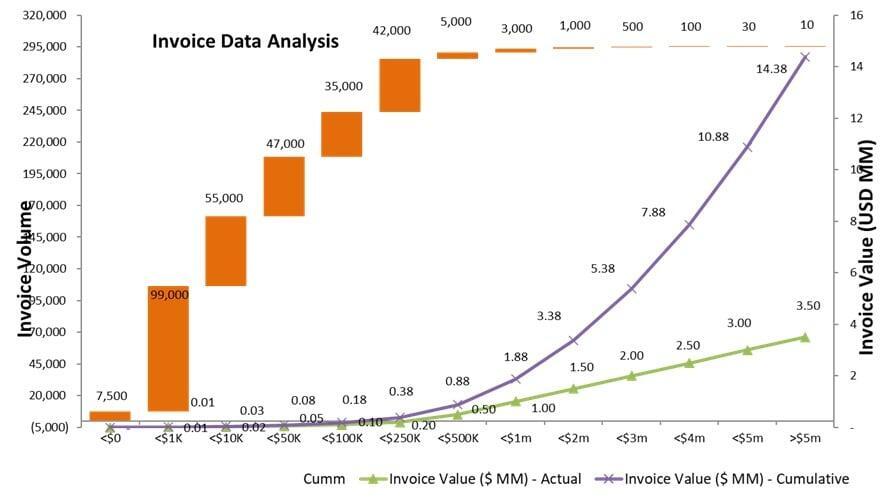
The Hidden Treasure in Tail-end Spend
At times, the cost of invoice processing and associated cost exceeded the value of the invoice itself. Many businesses do not optimize tail-end spend management. However, this can be as or more effective in improving the bottom line and should be one of the modern CFO’s priorities.
Large number of low value invoices is a reality in most businesses, which increases invoice management overheads. Many times, the cost of invoice processing, combined with purchase and associated cost, far exceeded the value of the invoice itself. Further, 60-70% of procurement employees are dedicated to processing these low value invoices. Despite the overheads, many businesses, for various reasons, are not serious about optimizing tail-end spend management. Tail-end spend management requires an effective process. While process deployment is critical, it's equally important to ensure process rigor.
This paper highlights how tail-end spend management can be more effective in improving the bottom line and should be one of the modern CFO’s priorities.

Attention Governments: Cybersecurity is Essential in a Digital World
As the digital world continues to expand, cybersecurity has taken center stage as an ever-growing concern.
Cybercriminals worldwide are leveraging advanced technologies to create increasingly sophisticated attacks, and the consequences of inaction are too significant to ignore.
Governments, businesses, and individuals must work together to build a framework that is resilient, adaptive, and secure.
https://www.tcs.com/insights/blogs/cybersecurity-new-frontier-digital-age
The CPO balanced scorecard
There’s no debate that cost effective sourcing contributes to a strong bottom line, yet businesses are currently facing many challenges to effective procurement and operations. Still, in many cases, resistance to change and corporate inertia result in organizations continuing to use highly distributed and “non-synergistic” systems. Even more challenging is the case of mergers/acquisitions, where corporations maintain existing systems to provide an illusion of a “business-as-usual” feel to internal stakeholders.
CPOs and CFOs across organizations, irrespective of size, type of business or growth strategies, need to align procurement with the vision of their organization. The most critical issues are disparate focus and incongruous strategies. The decision process for effective sourcing can not only be complex, but daunting. Critical to success is the decision related to the degree of centralization required within the procurement organization.
Centralized procurement lends a strategic advantage to organizations through economies of scale and collective buying power. However, in some cases a federal, coordinated or center-led structure works better. These models allow individual business units to act autonomously and minimize corporate overhead. However, due to lack of coordination each unit may end up with different prices and contractual conditions for the same supplies. How organizations can define their procurement models is a
critical process.
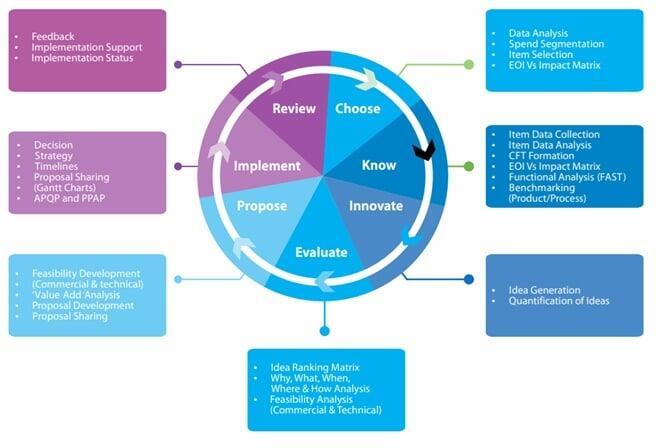
The right approach is to acquire a thorough understanding of the organizational dynamics affecting effective procurement. In our experience, an approach to innovation, as shown in Figure 1, requires an in-depth analysis of target elements, and a study of industry best practices and benchmarking. The results of the analysis are used to create a synergetic approach that aligns procurement goals with the organization’s goals.
Creating Synergies to Strengthen the Bottom-Line After M&A
Organizations face challenges in leveraging sourcing to enhance their bottom line. The situation is further complicated when organizations merge with or acquire other entities. Mergers and acquisitions (M&A) result in increasingly disparate procurement processes, raising the need for organizations to choose between decentralized, centralized, or center-led procurement set-ups. Explore how harmonized procurement processes, in a post M&A environment, can yield savings and enhance business value
Benefits of Lowest Interest Loan
- Issued by Indian Achievers Form · Jan 2022Issued by Indian Achievers Form · Jan 2022Indian Achievers Award
- Issued by Transformance Business Media · Jan 2021Issued by Transformance Business Media · Jan 2021Smart Digital Strategy Excellence Award
- Transformation Leader Of The YearIssued by SCMPro Forums · Jan 2019
▪ Generative Design Foundations
▪ Sales Enablement
▪ Special Initiative Award
▪ Certified Strategy Professional
▪ Blockchain – A Revolution Bigger Than The Internet by BSE Institute Limited
▪ Digital: Internet of Things (IoT) _ Foundation by TCS
▪ Digital Transformation Across Extended Supply Chain by SAP
▪ Coupa Platform & Implementation by Coupa
You are New One! Feel Free To Connect
SMS/WhatsApp/Telegram me: +91 99870 06393
or
email me at:
ckraina@ckraina.com
ceekay.raina@gmail.com
